Recession and horses – Part 1
 Although I started writing this post a year ago, it’s just as relevant today. It doesn’t seem like things have improved much with the economy since then and in many ways, things have become worse. The effects of this current recession are widespread when it comes to horses. I’m no expert and I don’t run an equine-related business for a living but the evidence is all around me and is very noticeable.
In the news
Tempe’s horse-mounted patrol may be cut to save money
The whole idea for this post came as a result of an article I saw on the Arizona Republic’s website AZCentral about Tempe, Arizona’s horse-mounted police patrol possibly being cut or eliminated to save money. Arizona is in a world of hurt this time around and they’re cutting all over. But it was particularly sad for me to see this historical use of horses (they’ve been doing it 35 years now) be shut down.
I’m a subscriber to several news feeds and I see news articles almost every day from all over the U.S. about horses being neglected, malnourished and sometimes rescued. Even Time magazine did an article on “An Epidemic of Abandoned Horses“. A couple of other recent examples:
Marion County authorities investigate horse deaths
Effort Underway to Treat Horses in Indiana
Local Observations
At a local horse and tack auction, horses are regularly brought in to sell that have been underfed. Someone typically rescues them from a family who can no longer afford to feed them and tries to sell the horse to someone who can. Some of these are fine looking horses, except for being thin. We often hear stories about horses being found and no one claiming them. Sometimes at livestock auctions, farmers return to their cow trailers to find a horse or two tied to their trailer with a note saying someone can’t take care of them anymore. How sad.
Horse sales are way down locally and prices have dropped dramatically for all but the best trained and most in-demand horses. Good barrel horses can still command $5k-$10k but regular old trail horses and horses without much training routinely sell for $25 to $50 (more for special colors, such as solid white). We hope these horses go to good homes but worry than some won’t. Some probably end up in Canadian or Mexican slaughter houses.
In part 2, I’m planning to bring up how the poor economy has changed the market for horse products and services such as feed, tack and fencing.
How about you? Has the economy changed the way you purchase products or services for your horses? Have you seen evidence of a higher rate of neglect and abandonment in your area?

 This just makes me sick. The U.S. Bureau of Land Management (BLM) is considering slaughtering thousands of horses because of budget problems. Why should an animal that was designed to live without human interaction be killed because our economy has slowed? It’s hard to not react emotionally to this story. So we round up horses that run free and wild, hold them captive and then because there aren’t enough buyers for them, we kill them. For our own convenience, really. Disgusting. And I don’t buy the “overcrowding” argument. It’s estimated there are 25,000 wild mustangs in the U.S., some of which are on protected Indian land. Have any of you ever seen a wild horse in the wild? I’ve seen about four. For those of you who have traveled anywhere out west you’re sure to remember the immense distance from rest stop to rest stop, with nary a building in between. I’ve traveled the great American west and can tell you there is no shortage of uninhabited land. The map below illustrates this nicely. All of the areas in yellow are BLM land: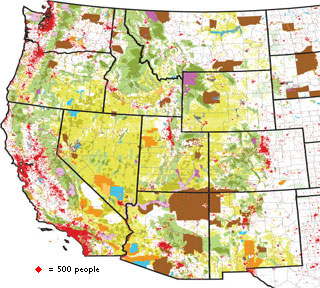
 In addition to our expensive horse hobby, we have an expensive Jeep hobby, too. We have a modified Jeep Wrangler and love to go off-road. Some of you may know that off-road trails across the country have steadily dwindled as certain interest groups have pushed to have them closed to “protect the environment.” I guess that’s not surprising, since a few off-roaders have given us all a bad name. What is surprising, however, is that the same battle is being fought over horses. That’s right; there are many, many people out there who want to deny trail access to horseback riders. Believe it or not, one of their most frequent arguments is that horses are bad for the environment. Their hooves tear up the trails and their manure brings in foreign plant seeds, among other things. I’m sure they have other complaints, but we’re still kind of new to this issue.
 The important thing is, if we want to be allowed to keep riding in our own national parks, we have to take action. Trails across the country are being closed just because someone complains, or brings up an environmental concern, and no horse people speak up. I suspect it’s simply because, like us, horse owners are not aware that this is happening. By the time they find out a trail is closed or about to close, it’s too late.
 Bill found this story on FOXNews.com, and I found a direct link to their blog:


